Baylor UniversityMechanical Engineering

Project

Oxide Dispersion During Friction-Based Magnesium Manufacturing

A U.S.–U.K. program to understand and control oxide-particle formation and dispersion during solid-state manufacturing of magnesium alloys for space.

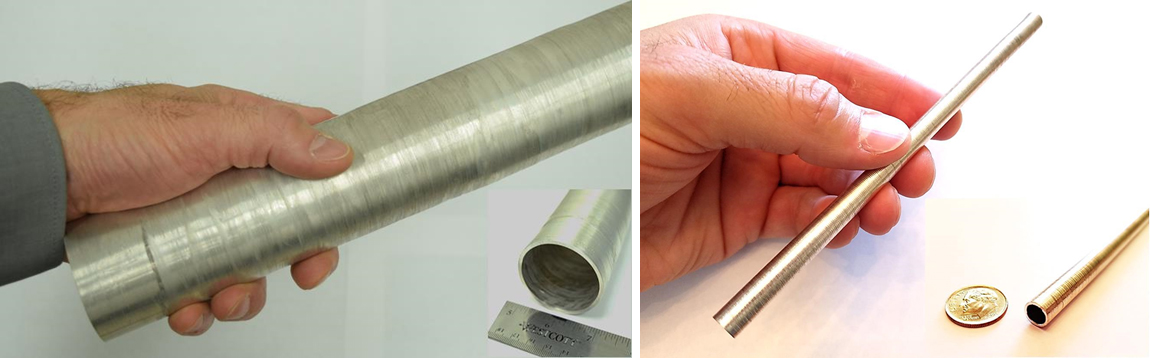
Friction-processed ZK60 magnesium alloy tubes illustrating solid-state magnesium manufacturing
Related solid-state magnesium processing: friction-extruded ZK60 tubes produced with the ShAPE process.S. Whalen / Pacific Northwest National Laboratory, CC0 · Source ↗

Project overview

This NSF–EPSRC project investigates how native magnesium and rare-earth oxides form, fragment, and disperse during friction stir processing and additive friction stir deposition. The work progresses from pure magnesium to Mg–Y and a commercial rare-earth magnesium alloy, combining controlled processing atmospheres with microscopy, synchrotron methods, atomistic simulation, and mesoscale modeling.

Performance studies include tensile and creep testing up to 300 °C, cryogenic testing to −196 °C, vacuum thermal cycling, and helium-ion irradiation relevant to low-Earth-orbit service. The goal is a mechanistic pathway to lightweight oxide-dispersion-strengthened alloys.

magnesium alloysoxide dispersionadditive friction stir depositionspace materials

Program focus

Turn normally detrimental surface oxides into a controlled strengthening dispersion for lightweight structural alloys.

Lead U.S. institution; Dalong Zhang is principal investigator.

  1. 01

    Cast and pre-disperse native oxides

  2. 02

    Apply friction stir processing and additive friction stir deposition

  3. 03

    Resolve oxide evolution with multiscale characterization and modeling

  4. 04

    Test performance across thermal, cryogenic, vacuum, and irradiation conditions